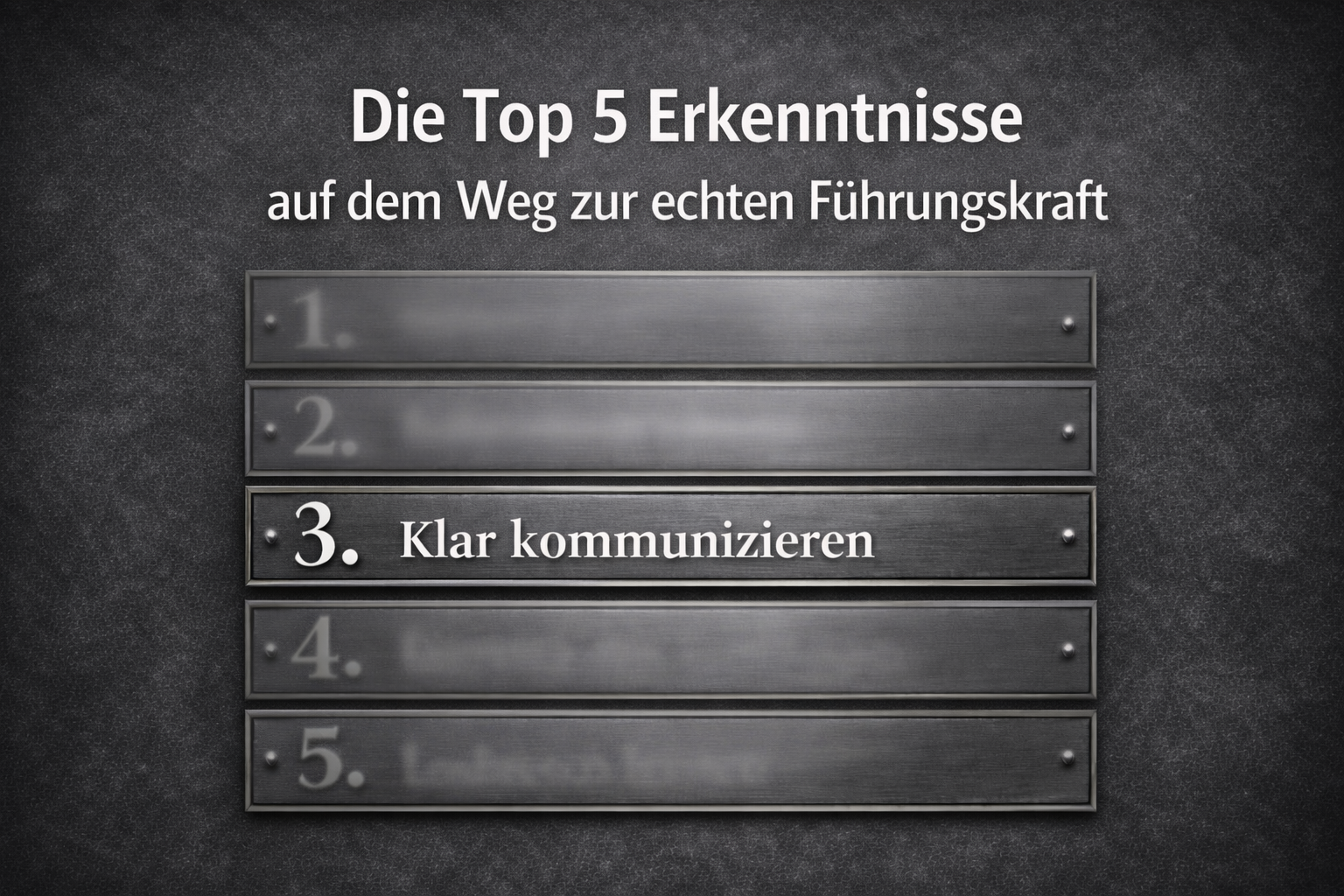
1. Clarity is not a talent, it’s a learning curve
Last week, I started with ranks 5 and 4: learning to delegate and let go, and accepting that you can’t control everything. Both are classic learning fields for people who step into leadership for the first time.
Rank 3 is closely connected to these - and at least as challenging: communicating clearly.
Almost every leader tells me in hindsight:
“I thought I was being clear. I wasn’t.”
2. Talking a lot is not the same as being clear
Especially new leaders tend to communicate a lot. They explain, justify, relativize, try to take everyone along, and avoid pushing too hard. The intention is good -but the effect is often the opposite.
Unclear communication rarely stems from a lack of commitment. It usually comes from too much consideration:
-
You don’t want to hurt anyone
-
You want to keep options open
-
You hope things will “sort themselves out”
The result is often confusion. Teams don’t know what is truly expected. Priorities remain vague. Decisions feel reversible - even when they are not.
3. Clarity does not mean harshness
One misunderstanding comes up again and again: that communicating clearly means being tough, dominant, or uncompromising. Many leaders want to be modern - to give space rather than dictate. Softer language feels more appropriate, more open, more pleasant.
In reality, the opposite is true.
Clarity means:
-
I say what has been decided
-
I say why
-
And I say what this means in concrete terms
Without fog. Without back doors. Without trying to please everyone.
At the same time, I make clear where there is room for maneuver, where the team’s creativity is needed, and what still needs to be worked out together.
Many leaders only learn over time that clarity is relieving - not just for themselves, but above all for the team.
4. Why clarity is so difficult
Communicating clearly means taking responsibility. If you are clear, you can no longer hide behind misunderstandings. Decisions become visible - and therefore vulnerable.
That’s why clarity is often the point where leadership becomes personal. You take a stance. You position yourself. You stand for something.
That takes courage - and practice.
5. My recommandation
Where in your leadership day-to-day are you being “considerate” rather than clear?
Which message are you hoping others will “understand correctly” without you stating it explicitly?
And what would happen if you expressed it calmly, clearly, and without qualification?
Because clarity is not a sign of dominance.
It is a sign of respect - toward yourself and toward others.