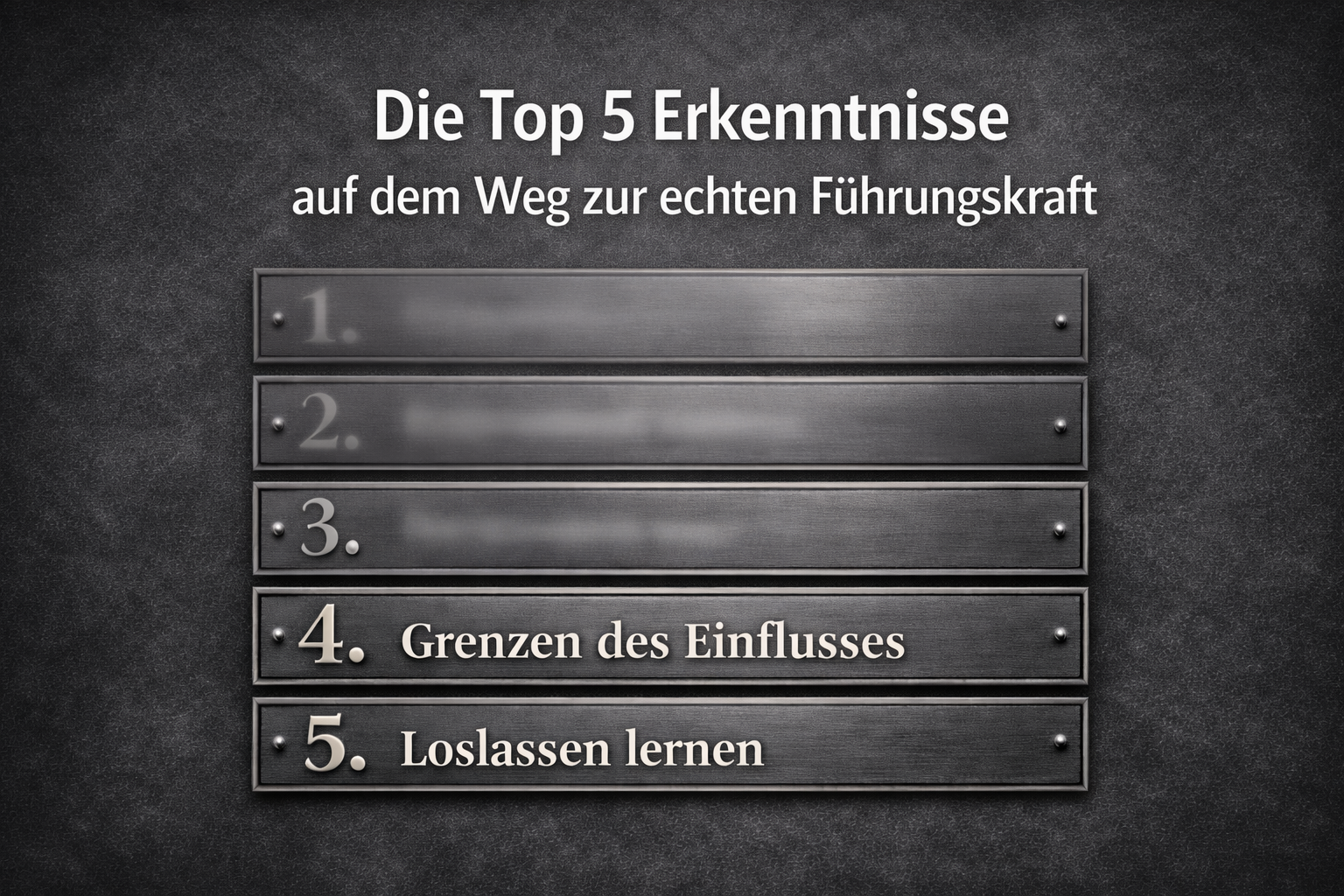
Today: Ranks 5 and 4 of the list
In the last Blog article, I described a question I particularly like to ask in interviews with leaders: What have you learned about leadership?
This question almost always takes the conversation to a deeper level very quickly. It doesn’t aim at methods or role descriptions, but at development. At what people only understand over time - often through friction, overload, and course corrections.
Across many conversations, I’ve heard very similar answers. Not theories, but real learning experiences. In the coming articles, I want to share the five most frequently mentioned - and in my view most relevant - insights.
The order reflects both their importance and the typical development path of leaders. I start with ranks 5 and 4 - topics that are most often mentioned when people take on leadership for the first time. That phase where you’re still deeply rooted in your functional role and used to doing many things yourself.
Rank 5: Learning to Delegate and Let Go
Delegation is one of the classic leadership learning moments - and almost never because it came easily.
Many new leaders begin with the ambition to keep everything under control. After all, they were successful precisely because they personally handled, monitored, and took responsibility for things. Delegation initially feels like a loss of control. This is often where what later gets labeled as micromanagement emerges - not out of bad intent, but because two key learning steps haven’t yet been completed: letting go, and accepting that other people will approach things differently than you would. And trusting that team members will deliver the agreed results - in their own way.
Micromanagement is therefore rarely a character issue. It’s usually a development issue. A sign that someone is still mentally anchored in their functional role and sees leadership as an extension of control rather than as enabling others.
At some point, reality sets in: this can’t continue. Not because of a lack of commitment, but due to overload - and because both employees and superiors begin to question whether the role is simply too much. That’s when the real insight often follows: delegation rarely fails because of the team. It fails because of one’s own inability to let go. Because of struggling to tolerate different approaches. Because of a lack of trust that results can be good even if they’re achieved differently than one would have done personally.
Many describe this moment as a turning point in their leadership role.
Rank 4: Accepting That You Can’t Influence Everything
Closely connected to this is a second insight many describe as painful: you can’t control everything.
Especially early on, expectations are high. You want to build a strong, motivated, harmonious team. An environment where everyone works well together, values one another, and is supportive. Some of that works. Some of it doesn’t.
A frequently mentioned example is personal friction within teams - tensions, antipathies, old conflicts. Things a leader can moderate, accompany, and partially influence, but often cannot fully resolve. Many say they initially believed it was their responsibility as a leader to resolve every conflict and ensure complete harmony.
Another commonly cited challenge is the relationship with team members themselves. While close collegial bonds - and sometimes friendships - often exist on the same hierarchical level, relationships as a leader to one’s team are usually more complex. This becomes particularly challenging when someone is promoted from within the team to lead that very group. Existing relationships can suffer.
The realization that some things - especially interpersonal dynamics - cannot be changed marks an important maturity step for many. Leadership means influence, but not omnipotence. Organizations are not machines; they are social systems. Not everything is controllable, even if we would like it to be.
This insight is relieving - and it sharpens the focus on what actually can be shaped.
Why These Two Learnings Belong Together
Delegating and accepting the limits of one’s influence are closely connected. Both require a shift in one’s understanding of the role. Away from doing everything yourself, toward enabling others. Away from the need for control, toward clarity and trust.
Many describe this as the transition from functional strength to real leadership.
My recommandation
What was harder for you to learn: delegating tasks or accepting the limits of your own influence? Where have you perhaps tried for too long to control things that cannot be controlled? And what changed when you began to let go?
Because leadership doesn’t develop through perfection - but through insight, trust, and experience.