1. Three Challenges That Come Up Almost Everywhere
When I work with leadership teams in workshops and we discuss what works well in their organizations and where collaboration becomes difficult, we almost always end up talking about corporate culture. Three themes come up particularly often: transparent communication, ownership, and cross-functional collaboration.
The larger and more complex an organization becomes, the harder these things seem to get. Information has to travel through more layers, responsibility is spread across different departments, and people increasingly focus on optimizing their own work and their own area rather than keeping the company as a whole - or the customer - in mind.
We discuss these challenges regularly in workshops. Recently, however, I came across an example in an unexpected place where all three came together in a remarkable way.
2. An Enormous Board on a Construction Site
During my trip to Rwanda, which I have already written about here, we visited several large construction projects. These included residential developments with up to 100 apartments, each with a total construction period of approximately two years.
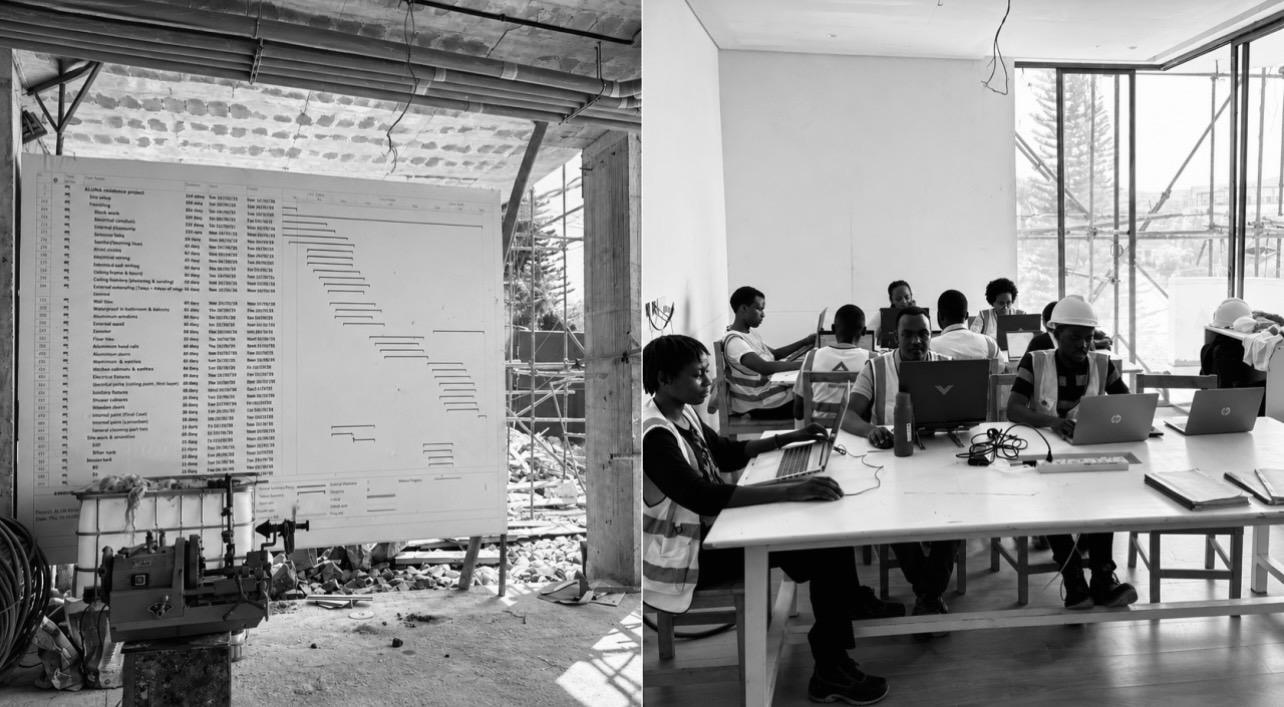
What immediately caught my attention was an enormous board at the entrance to each construction site. Several meters high and wide, it displayed a detailed schedule of every stage of construction, from breaking ground to completion. Every individual trade and task was listed, assigned a place in the timeline, and linked to a person responsible for it. Once a task was completed, the person in charge signed it off.
You could stand in front of that board and, within minutes, understand how far the project had progressed, which tasks had been completed, and what was coming next. An impressively simple way of making the entire project transparent. And it required neither sophisticated software nor a digital dashboard.
3. Everyone Works in the Same Place
What I found even more interesting was how the work itself was organized. The group of companies employs all the people needed for the different trades directly. Electricians, carpenters, and other skilled workers are all part of the same organization. Rather than coordinating numerous subcontractors with different interests and priorities, everyone works together on the same project. Everyone.
And it did not stop there. The office-based professionals - architects, engineers, construction managers, and procurement staff - were not sitting at some distant location, occasionally visiting the construction site. They worked right there, in an improvised open-plan office inside the unfinished building. Whenever a problem arose, nobody had to schedule a meeting with another department. The people needed to solve it were just a few meters away.
Even lunch was part of this approach. At lunchtime, everyone stopped working and ate together. The meals were prepared and delivered by a central kitchen belonging to the same group of companies. I was impressed by how consistently even seemingly minor aspects of collaboration had been considered.
4. A Culture You Can Actually Observe
According to the company, the results of this approach have been remarkable: previous projects have regularly been completed several months ahead of schedule, with high quality and no significant defects. I cannot independently verify these claims. But what we observed on the construction sites certainly helped explain why this organization might perform so well.
Transparency was not an abstract aspiration. Everyone could see exactly where the project stood.
Ownership was not lost somewhere between departments. Every task had a clearly identifiable person responsible for it.
And cross-functional collaboration did not have to be encouraged through workshops or additional meetings. It was built into the daily way of working.
The three cultural values we talk about so frequently in organizations were embedded directly in how the work was organized. Perhaps that was my most important observation: culture is not defined by the values a company puts into words. It reveals itself in how the company actually organizes collaboration.
5. What Can Other Organizations Learn from This?
Of course, it would be far too simplistic to treat this model as a blueprint for other companies. An international software company cannot bring all its employees together in one location. An organization with many different products and projects needs different structures from a construction business. And not every service has to be provided in-house to work well.
Nor is remote work inherently incompatible with good collaboration. It simply places different demands on communication and coordination.
For me, the more interesting question is this: How much organizational complexity do we take for granted, even when it makes collaboration unnecessarily difficult?
We create responsibilities, departmental boundaries, reporting lines, and coordination processes. Often for good reasons. But every additional interface also increases the risk of information getting lost, decisions taking longer, and nobody feeling responsible for the overall result.
On the construction sites in Rwanda, I had the impression that the organization was making a very deliberate effort to minimize precisely these sources of friction. Not by appealing to employees to behave differently, but by designing the organization accordingly.
6. My Impuls
We talk a great deal about corporate culture. We define values, discuss leadership principles, and consider how to improve transparency, ownership, and collaboration. Perhaps we should ask ourselves a different question more often: How easy do we actually make it for people to put these values into practice every day?
Can our employees see at any time what we are working on together and how far we have progressed? Is it clear who takes responsibility for the outcome, even across departmental boundaries? And how many unnecessary obstacles have we placed between people who are supposed to be solving problems together?
Those construction sites in Rwanda certainly taught me more about the practical meaning of corporate culture than many elaborate presentations on company values.
Because a strong culture does not emerge simply because we expect people to behave in the right way. We also have to design our organizations so that the right behavior becomes possible - and natural.