1. An Article About Mistakes
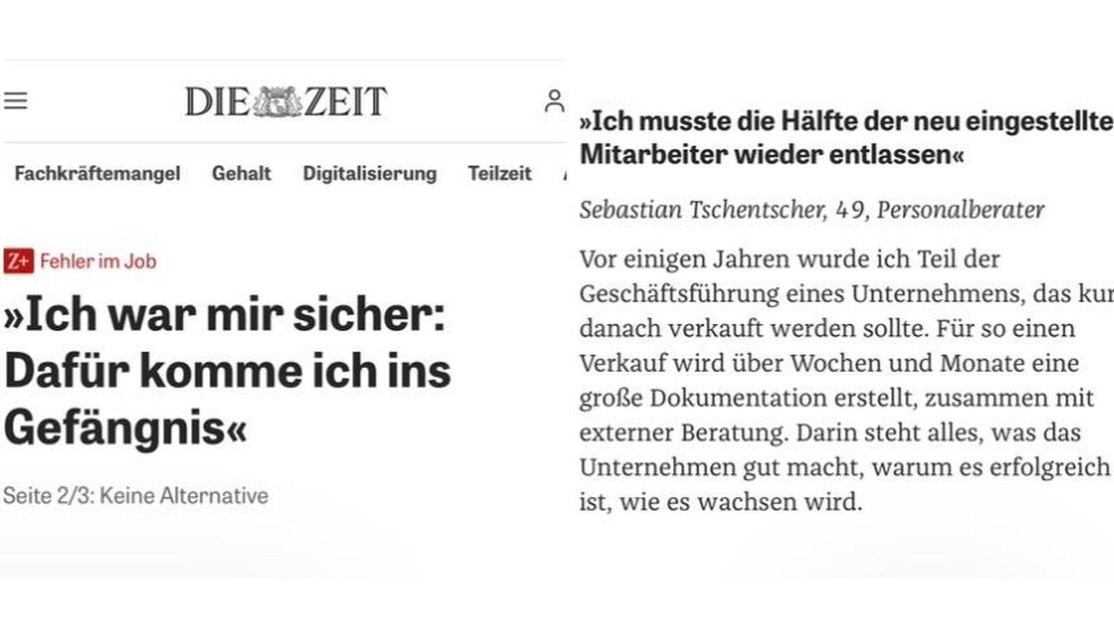
A few days ago, DIE ZEIT published an article in which three people talk about major mistakes they made in their professional lives.
I am one of them.
I spoke about a management decision that I would make differently today. About enthusiasm, overly optimistic growth assumptions, and the fact that, in the end, people lost their jobs. I read and approved my part of the article before publication. I stand by every word.
Then the article was published. The headline read: “I was certain: I’m going to prison for this.” Except I had never said that. The quote came from one of the other two stories.
2. Everything Is Correct and Yet It Creates the Wrong Impression
There is nothing factually wrong with the headline. Someone featured in the article did indeed say those words. And yet, it made me uncomfortable.
Because someone who sees the headline and then sees my name associated with the article could easily make a connection that does not exist. And anyone who does not read the full article - or cannot access it because of the paywall - may have no way of correcting that impression.
I spent some time thinking about why this bothered me so much. After all, nothing incorrect had been attributed to me, and my own story had been reproduced accurately. Perhaps that is precisely what makes the question so interesting: Is it enough for good communication that everything we say is factually correct?
3. Even a True Statement Can Convey Something False
We encounter this problem in management all the time. We present a figure that is completely accurate but leave out the comparison that would put it in a different light. Or we announce a reorganization as “the next step in our development,” even though everyone in the room already knows that it is primarily about reducing costs.
None of these statements necessarily has to be false. And yet, the message received may be quite different from the one we believe we communicated. Communication is not simply a collection of statements that are either true or false. It is shaped by words, context, omissions, and the way people connect all of those elements.
4. Sender and Receiver Do Not Bear the Same Responsibility
Of course, this idea cannot be taken indefinitely far. No one can control what other people make of a statement. People misunderstand things, interpret them differently based on their own experiences, or sometimes simply hear what they want to hear.
But in my view, leaders make things too easy for themselves when they fall back on saying, “That’s exactly what I said,” or, conversely, “I never said that.” Because anyone who communicates bears at least some responsibility for anticipating what the other person is likely to take away from the message.
This is particularly important where there is an imbalance of power or information. Leaders often know more of the background than their employees do. What seems perfectly clear to them because of that knowledge may mean something entirely different to someone who does not have the same context.
5. Truth Needs Context
Perhaps, then, the question before an important communication should not simply be: Is what I am saying correct? Other questions are at least as important: What impression is this likely to create? What information is the other person missing in order to interpret my statement correctly? And would I still consider the message fair if I knew only what the recipient knows?
That makes communication more demanding. It is no longer enough to check individual statements for factual accuracy. We have to try, at least for a moment, to see our own message from the other person’s perspective. My experience with the ZEIT article reminded me of exactly that.
6. My Reflection
When communicating something important, how often do you consider not only whether what you are saying is correct, but also what impression it is likely to create?
Have you ever said something that was factually completely accurate and yet caused the other person to take away something entirely different?
And where, in your view, is the line between the sender’s responsibility to communicate clearly and the receiver’s responsibility for how they interpret the message?
Because good communication requires truth. But sometimes truth alone is not enough. It also needs context.