1. Success Is the Natural Enemy of Change
Whenever people talk about the major corporate failures of recent decades, the same names almost always come up: Kodak and Nokia.
The common explanation is that both companies were caught off guard by technological revolutions and ultimately swept away. Digital photography replaced film, the iPhone transformed the mobile phone market, and the former market leaders simply had no chance to catch up.
But that is only part of the story.
In reality, both companies had ample time, financial resources, world-class engineers, and the necessary expertise to respond. Kodak even invented the first digital camera itself. Nokia was posting record sales and profits when Apple introduced the iPhone in 2007.
In neither case were they powerless in the face of change. Their real challenge was driving transformation despite the success they were already enjoying.
2. Yesterday's Success Quickly Becomes Tomorrow's Obstacle
That is the paradox.
The more successful a company is with its existing business model, the less urgency there seems to be for fundamental change. Processes are optimized, products are thriving, and past decisions have been validated for years. Anyone calling for a radical change of direction is no longer arguing against a problem - they are arguing against success.
That is why transformation is rarely a technical challenge. It is primarily an organizational and cultural one. The greatest obstacle usually does not lie outside the company but within its own structures and ways of thinking.
More broadly, one principle seems to apply: whenever the pace of external transformation exceeds the pace of internal transformation, organizations begin to lose relevance.
We can observe this mechanism today - not only at Volkswagen, but across many established companies. As long as the existing business continues to generate billions, it is extraordinarily difficult to invest decisively in a future whose exact shape remains uncertain.
3. A Pattern That Is Much Older Than Modern Business
Interestingly, this pattern is far older than the modern economy.
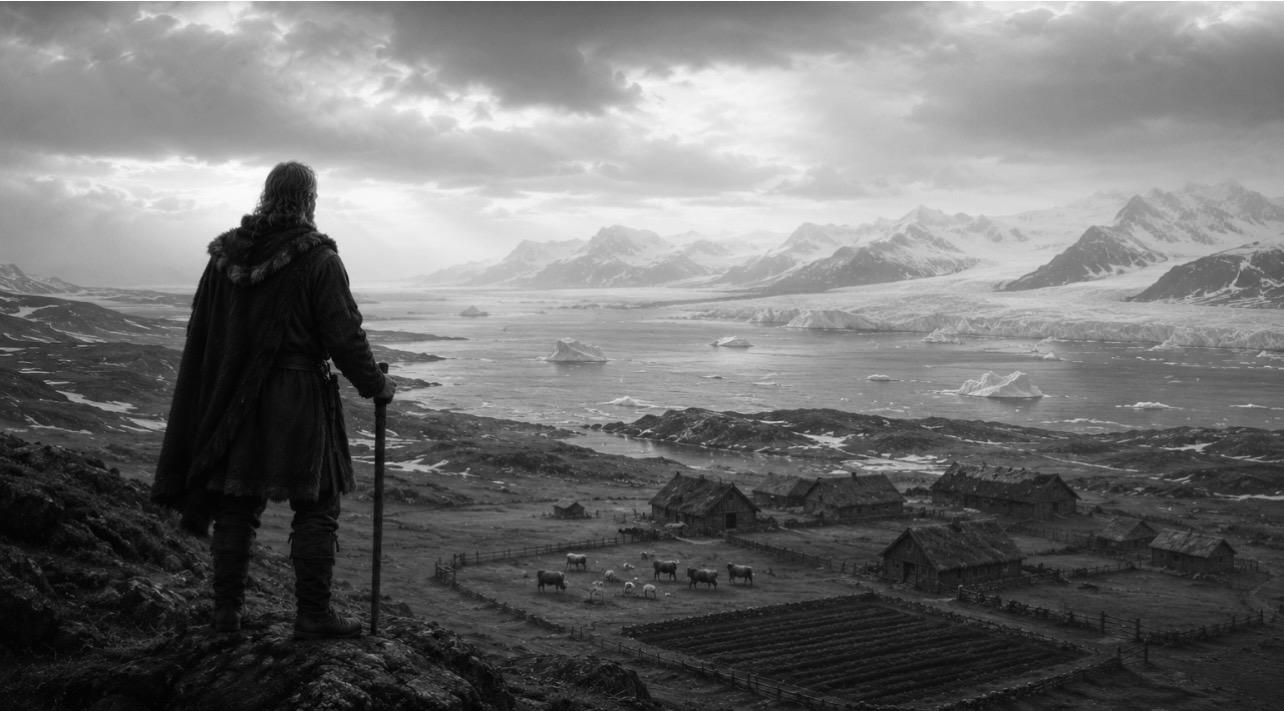
Around 1,000 years ago, the Vikings established settlements in Greenland. During a warm period that lasted for several centuries, they successfully relied on farming and livestock. As the climate gradually cooled from the 13th century onward, their living conditions slowly deteriorated. At the same time, the Inuit were already living there with a way of life that was far better adapted to the changing environment.
Historians continue to debate the exact reasons why the Norse settlements disappeared. One thing, however, is clear: external change alone does not explain what happened. There was time to adapt. A key factor was how difficult it proved to fundamentally change a model that had been successful for generations. In fact, evidence suggests that the Vikings even tried to intensify farming and livestock production in an effort to preserve their former success despite increasingly unfavorable conditions.
4. AI Confronts Us with the Same Question
Today, artificial intelligence presents us with another technological transformation whose long-term consequences no one can predict with confidence.
I do not know which professions will change or which business models will still exist ten years from now. Most likely, no one does.
One thing seems likely, however: the greatest risk is not that companies fail to recognize the potential of AI. The greater risk is that the success of today's processes overshadows the need for change. As long as the current business continues to perform well, it seems perfectly reasonable to keep optimizing what already works.
And that may be exactly where the real trap lies.
5. My Impuls
Does the fact that your business is still performing well despite all the discussion around AI give you a sense of reassurance?
Could that very success also be the strongest reason why fundamental change feels so difficult?
And how would you know if your greatest challenge is not a lack of knowledge - but the willingness to question the success of yesterday and today before it is too late?